
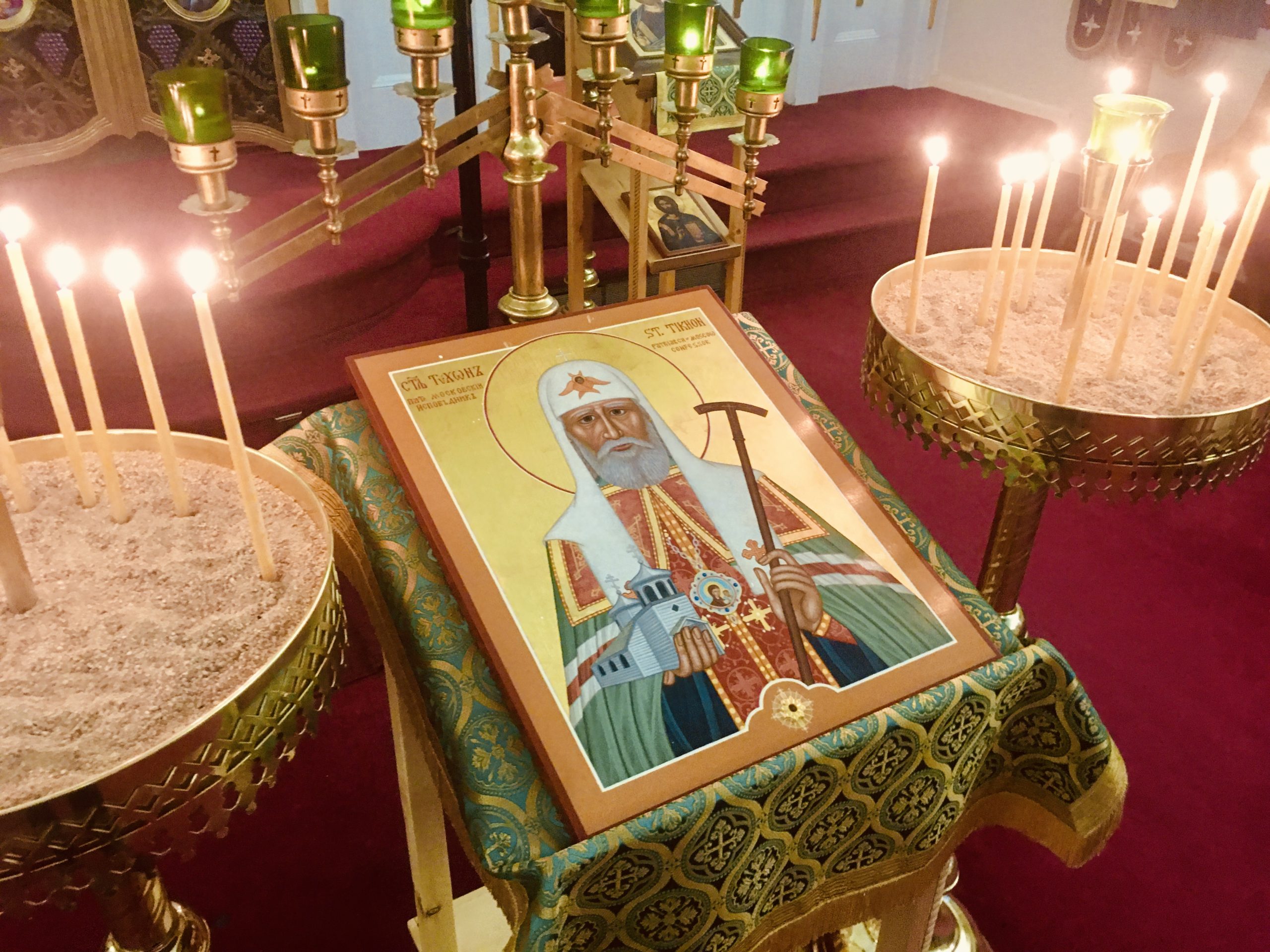
St. Tikhon, Patriarch of Moscow
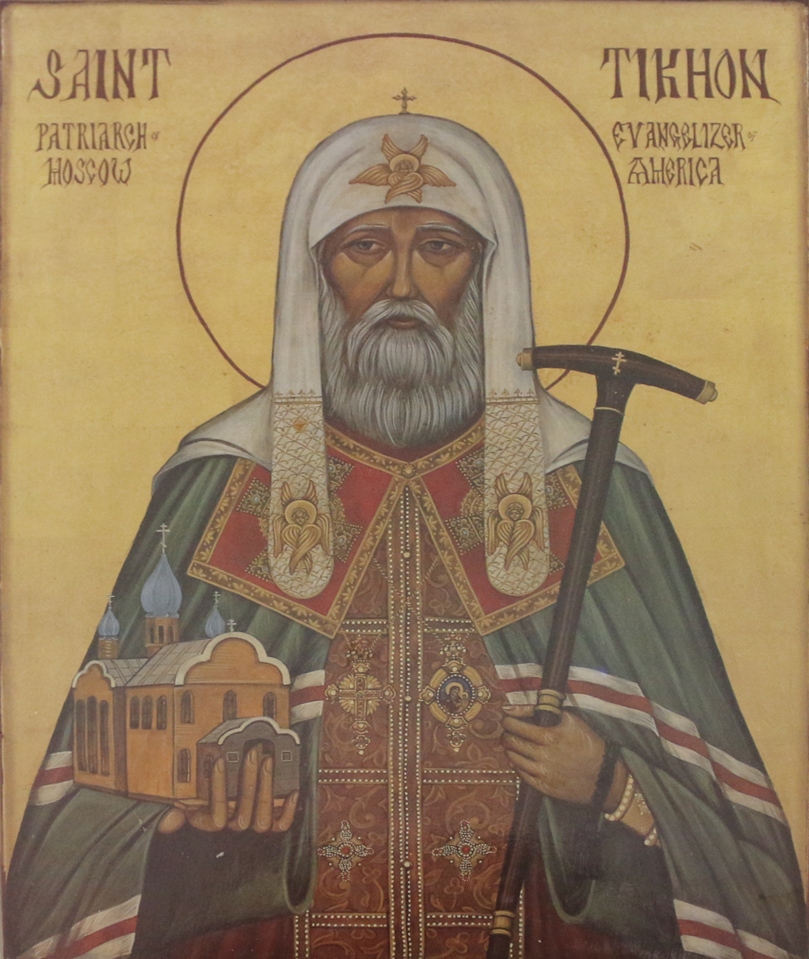
Saint Tikhon was born Vasily Ivanovich Belavin on January 19, 1865, in the Pskov diocese, the son of a rural priest. He showed early devotion and an unusual humility through a childhood spent among the peasants of his village.
From 1878 to 1883 he attended the Pskov Theological Seminary, where classmates nicknamed him “bishop” and “patriarch” for his piety and scholarship. He graduated from the St. Petersburg Theological Academy in 1888 and returned to teach at Pskov. In 1891, at twenty-six, he took monastic vows and received the name Tikhon in honor of St. Tikhon of Zadonsk.
He became archimandrite at the Kholm Seminary in 1892, was consecrated Bishop of Lublin in 1897, and in 1898 was appointed Bishop of the Aleutians and Alaska. As head of the Orthodox Church in America he reorganized the diocese, founded churches including St. Nicholas Cathedral in New York, consecrated the ground of St. Mary’s in Calhan, and was made an honorary American citizen. In 1905 the American mission became an archdiocese and Tikhon its archbishop.
He returned to Russia in 1907 to serve in Yaroslavl, then in 1913 in Lithuania, where he organized relief during the First World War. After the February Revolution he was elected ruling bishop of Moscow on June 21, 1917, elevated to metropolitan on August 15, and chaired the council that restored the Patriarchate.
On November 5, 1917, after a drawing of lots before the Vladimir Icon of the Mother of God, Metropolitan Tikhon was chosen Patriarch. He compared his election to the scroll the Prophet Ezekiel was made to eat, on which was written “lamentations, mourning, and woe,” foreseeing that his ministry would be one of suffering.
His patriarchate coincided with the Soviet seizure of church property, the persecution of clergy and staged trials. When famine struck the Volga in 1921 he authorized voluntary gifts of non-liturgical valuables, but the government’s forcible confiscation decree of February 1922 could not be reconciled with the canons. Nearly two thousand trials followed and more than ten thousand died. Tikhon himself was imprisoned from April 1922 until June 1923.
Through the schisms and persecutions he held to the faith without compromise, saying of the returning schismatics that he would make no concession that could cost the purity and strength of Orthodoxy.
Worn down by it all, he fell ill in 1924, served his last Liturgy on Sunday, April 5, 1925, and died two days later after making the sign of the Cross and saying, “Glory to Thee, O Lord, glory to Thee.” Nearly a million people came to his funeral at the Donskoy Monastery in Moscow. He had served as Patriarch for seven and a half years.
The Council of Bishops of the Russian Orthodox Church glorified him as a saint on September 26 / October 9, 1989. His relics, lost for nearly seventy years, were found at the Donskoy Monastery in February 1992.
May God teach every one of us to strive for His truth, and for the good of the Holy Church, rather than something for our own sake.